For over 15 years, hotel reputation management followed the same routine:
- Collect reviews from Google, Booking.com, and TripAdvisor into one inbox.
- Track broad scores like GRI or NPS.
- Set alerts for negative reviews.
- Reply with canned response templates.
In 2026, this traditional playbook no longer works.
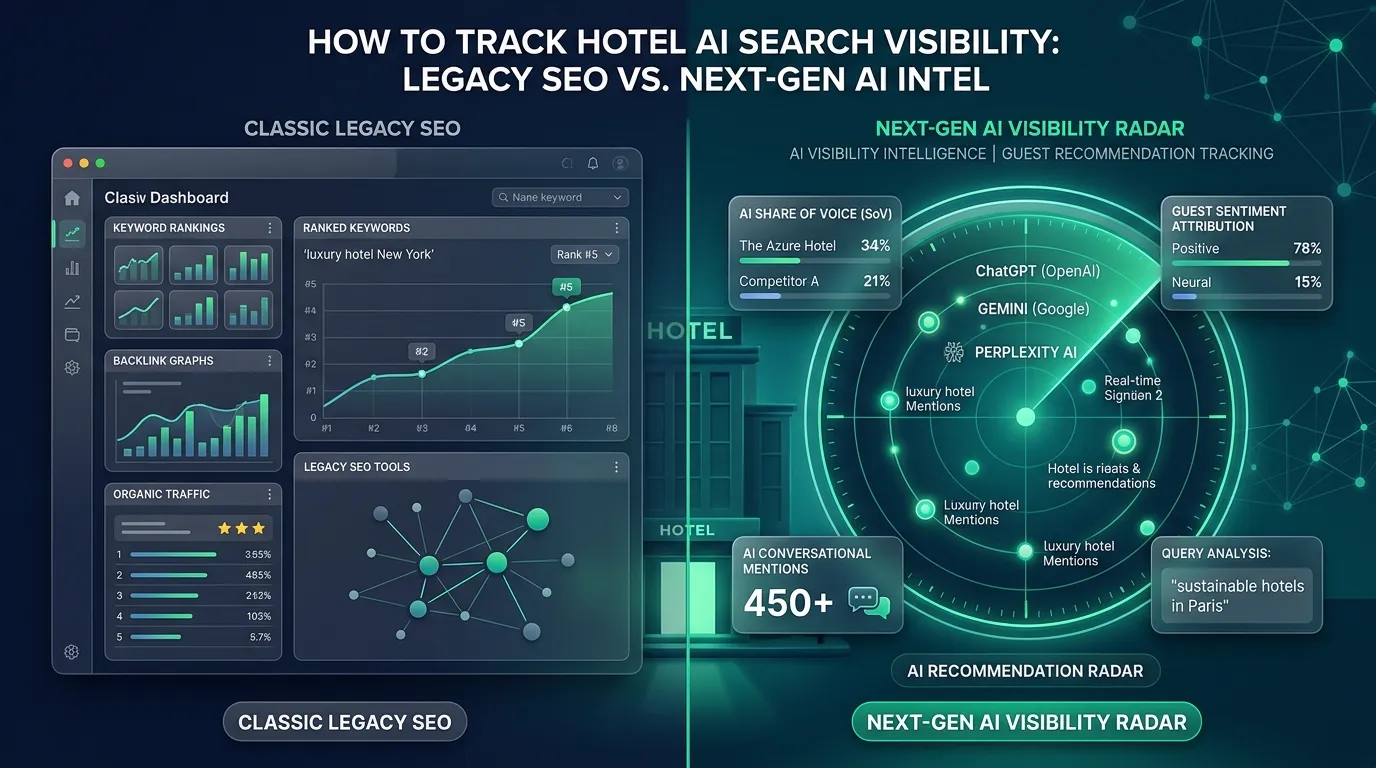
Travel discovery has fundamentally changed. Over 40% of luxury, boutique, and independent hotel searches now happen through AI assistants—including ChatGPT, Google Gemini, Perplexity, and Apple Intelligence.
Imagine a traveler asks an AI assistant:
The AI does not look at promotional websites or outdated surveys. Instead, it reads and summarizes hundreds of recent, public guest reviews across the web.
If recent reviews mention thin walls, broken air conditioning, or slow check-in, the AI skips the hotel. Legacy dashboards only show general ratings, so managers rarely know why AI assistants overlook their property.
To win bookings today, hotels need to know how AI models evaluate guest sentiment—and why legacy dashboards fall behind.
The Three Core Limitations of Legacy Reputation Dashboards
Most traditional reputation management tools were created between 2008 and 2015. They were built for passive tracking and monthly reports. In the AI era, they face three major limits:
1. Passive Aggregation vs. Root-Cause Diagnosis
Old tools track star ratings and count words (such as noting that "service" appeared 40 times). But high-level numbers do not reveal why an AI engine left your hotel off its shortlist.
A hotel might maintain a strong 4.3 rating on Google. Yet a few recent complaints about noisy elevators or slow check-ins can quietly disqualify it from high-intent AI queries.
- Legacy blind spot: Broad averages hide specific operational flaws.
- AI reality: Conversational engines filter properties based on exact, recent guest experiences.
2. The Pitfalls of Boilerplate Templates
Older systems encourage quick replies using canned response templates. But copy-pasting the same reply harms your property in two ways:
- Guests notice immediately: Travelers easily spot boilerplate replies. It makes hotel management feel detached and uncaring.
- AI engines inspect management replies: Today's AI models read owner responses to evaluate service quality. Generic templates provide zero meaningful context for search engines.
3. The Disconnect Between Feedback and Search Visibility
In the past, hotel operations and SEO lived in separate silos. That separation has disappeared.
Today, guest feedback directly shapes AI search visibility. Frontier models rely on fresh reviews and active owner responses as key signals when deciding which hotels to recommend. When guest sentiment drops, your AI search visibility drops with it.
Architectural Requirements of Next-Generation Reputation Systems
Modern reputation systems need four core capabilities to succeed in AI-driven search:
Multi-Model AI Visibility Tracking
Monitors how often ChatGPT, Google Gemini, and Perplexity recommend your property across business, couple, and family search queries.
Aspect-Level Sentiment Analysis
Breaks reviews down into exact operational areas (such as AC noise, mattress comfort, or breakfast lines) instead of vague star scores.
Fast Multilingual AI Reply Assistance
Drafts personalized responses in the guest's language in seconds. It addresses exact concerns while staying true to your hotel's unique voice.
Rolling 30-Day Operational Health
Replaces sluggish annual metrics with real-time benchmarks like Hotel RPS, tracking review speed and negative review coverage.
Comparing System Architectures: Legacy Tools vs. Modern Intelligence
Here is a clear look at how traditional review tools differ from modern platforms like Signalia:
| Feature | Legacy Reputation Systems | Modern Intelligence (Signalia) |
|---|---|---|
| AI Search Discovery | No tracking of AI assistants (ChatGPT, Gemini, Perplexity) | Tracks how often AI models recommend your hotel for traveler queries |
| Root-Cause Analysis | Basic word counts and overall star ratings | Aspect-level NLP that highlights exact guest issues |
| Response Workflow | Generic copy-paste templates or manual translation | Personalized AI reply assistance in 30+ languages in your hotel voice |
| Benchmarking Horizon | Slow 12-to-24-month historical indexes (GRI, NPS) | Rolling 30-day Hotel RPS tracking recent sentiment and review response speed |
| Setup & Access | Weeks of setup, complex API credentials, and annual lock-in | Zero IT setup, instant public review streaming, and flexible plans |
The Closed Feedback Cycle: Connecting Feedback to Discovery
Modern hotels connect daily operations directly to AI search visibility through five simple steps:
Bring All Reviews Together: Collect public guest reviews from Google, Booking.com, and TripAdvisor into one live feed.
Find Operational Friction: Spot recurring issues by department—such as housekeeping, front desk, maintenance, or breakfast.
Reply Fast in Your Hotel Voice: Respond promptly to all negative reviews with attentive, tailored answers in seconds.
Boost AI Search Visibility: Watch how resolving guest issues lifts your recommendation rate in ChatGPT, Gemini, and Perplexity.
Protect Direct Bookings & Rates: Strong recent reviews give travelers the confidence to book directly, defending your room pricing.
Empirical Context: How Review Scores Impact Hotel Performance
Academic research confirms that review ratings directly drive hotel revenue. A benchmark study by the Center for Hospitality Research at Cornell University found that:
A 1-point increase in a hotel’s online review score (for example, moving from 4.0 to 5.0) lets a hotel raise room rates by up to 11.2% without losing occupancy or market share.
In AI search, guest sentiment is even more crucial. Conversational assistants recommend only two or three top properties instead of endless search result pages. Hotels with high ratings, fresh feedback, and active replies earn the lion's share of direct bookings.
Conclusion
Travelers now rely on AI assistants to plan trips and choose hotels. Because of this shift, reputation management is no longer just about reading old reviews. It is about turning live guest feedback into an engine for AI discovery.
In 2026, leading hotels focus on three essentials: fixing operational issues quickly, replying to critical reviews in their authentic voice, and monitoring how AI models present their property to travelers.
Want to see how AI assistants evaluate your property today? Check your visibility with our free diagnostic: 👉 Free Hotel AI Visibility Audit or discover how our Hotel Reputation Intelligence Platform works.